
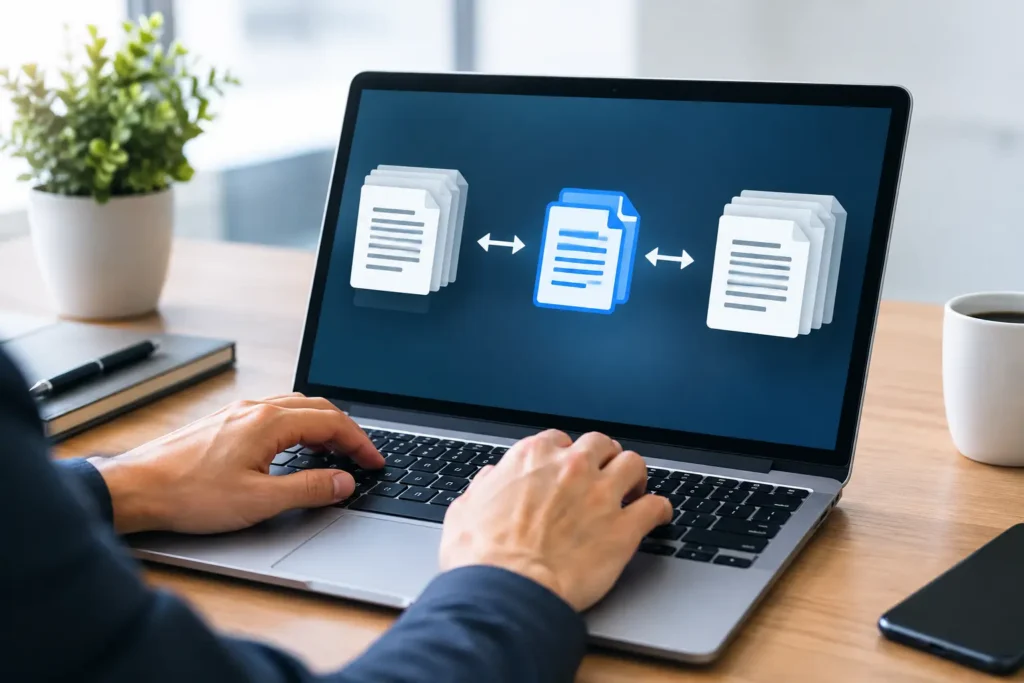
A 40-page contract with two revised paragraphs can consume nearly the same review time as its original, even when both versions tell the same story. Multiply that problem across email attachments, shared drives, cloud folders, and exported mobile data, and the review queue grows quickly. Near duplicate detection eDiscovery gives legal teams a practical way to identify document families that are substantially alike, focus attention on meaningful differences, and apply review decisions with greater consistency.
For litigation, investigations, and regulatory matters, this is not simply a productivity feature. Used correctly, near-duplicate analysis reduces avoidable review expense while preserving the ability to assess relevance, privilege, confidentiality, and context on a defensible record.
What Near Duplicate Detection Finds
Near duplicate detection identifies documents with highly similar content, even when they are not exact copies. The differences may be minor: an updated date, an inserted clause, a changed signature block, a handwritten annotation, or a few added email recipients. The technology analyzes text and other document characteristics to group materially similar items into a document family or similarity set.
This differs from exact deduplication. Exact deduplication removes or suppresses files that are identical at the data level, typically based on a hash value. If the underlying file changes by a single character, its hash changes and it is no longer an exact duplicate. Near-duplicate analysis is designed for that common reality. It recognizes that documents can be substantively similar while remaining technically distinct files.
Consider a set of quarterly reports circulated among executives. One version may include a revised revenue figure, another may have a comment from counsel, and a third may be converted to PDF. Exact deduplication may treat all three as separate. Near-duplicate identification can place them together so the reviewer can compare the versions efficiently and determine whether the changes matter.
Why Near Duplicate Detection eDiscovery Matters
The cost of document review is driven by more than total data volume. It is driven by the number of review decisions a team must make, the complexity of those decisions, and the time required to understand each document in context. Large populations of similar documents create repetitive work and increase the chance that reviewers reach inconsistent conclusions.
Near-duplicate grouping allows reviewers to assess one representative document, then compare related documents for meaningful variations. That supports faster review without treating similar documents as interchangeable. A small change can be legally significant, especially when it affects a negotiation, a compliance certification, a privilege notation, or a factual timeline.
The value is especially clear in matters involving iterative business documents. Draft agreements, policy revisions, presentation decks, reports, engineering specifications, and recurring forms often exist in many versions. Without analytics, reviewers may open each file individually and spend time rediscovering what has changed. With well-configured near-duplicate analysis, the review team sees the relationship sooner and can direct attention to the documents most likely to contain new information.
The result is a more disciplined review process. Teams can reduce repetitive reading, prioritize unique content, and improve coding consistency across similar populations. For corporate legal departments managing spend, that can translate into more predictable review budgets and better use of outside counsel resources.
Similar Does Not Mean the Same
Near duplicate detection is an analytical aid, not a basis for automatically withholding, producing, or deleting documents. Similarity scores reflect the degree of overlap between documents, but they do not determine legal significance.
A document that differs by only a few words may require separate review if those words change an obligation, reveal legal advice, identify a new custodian, or alter a key date. Likewise, two visually similar documents may contain different metadata, attachment relationships, or source information. Those distinctions can matter for authentication, privilege analysis, or a production protocol.
For that reason, a defensible workflow keeps the original documents intact and maintains clear visibility into each item in a similarity group. Reviewers should be able to open the representative document, compare related versions, and record decisions at the document level when needed. The goal is not to flatten the evidence. It is to organize it intelligently.
Where It Fits in the eDiscovery Workflow
Near-duplicate identification works best when it is part of a connected workflow, not an isolated feature applied late in review. The quality of the results depends on careful collection, processing, text extraction, metadata handling, and review configuration.
Collect and preserve defensibly
The process starts with sound collection and preservation. Data should be acquired from the relevant sources with documented chain of custody, appropriate access controls, and procedures that preserve original evidence. A similarity group is only as reliable as the underlying data population. If key custodians, cloud repositories, mobile sources, or attachments are missing, analytics cannot repair the gap.
Process documents for usable analysis
During processing, documents are extracted, normalized, and prepared for search and analytics. Text extraction and optical character recognition are particularly important. If a scanned PDF has no usable text, the system has less information for comparing it to related documents. File type, language, quality of scans, embedded content, and corrupted data can all affect the usefulness of near-duplicate results.
Prioritize review with context
Once the data is in a secure review platform, similarity sets can help the team sequence work. Counsel may begin with highly connected documents, representative versions, or documents within a key date range. Reviewers can then compare related items and apply coding decisions with the context needed to identify material differences.
This approach is often most effective alongside other analytics, including email threading, concept searching, metadata filters, and targeted keyword searches. Email threading can reduce repetitive review within a conversation, while near-duplicate analysis can identify similar attachments, revised reports, and parallel versions outside that email chain. Each tool addresses a different form of repetition.
Validate the results before relying on them
Quality control remains essential. Project managers and review leads should test similarity groups, examine samples across document types, and confirm that the grouping behavior supports the matter’s goals. A threshold that works well for a set of standardized forms may be too aggressive for technical documents or heavily revised contracts.
The right configuration depends on the case. In a fast-moving internal investigation, the team may use similarity analysis to accelerate issue spotting and prioritize interviews. In a high-stakes production, counsel may require closer document-by-document comparison before applying bulk actions. The defensible choice is the one that matches the evidence, the legal issues, and the agreed review protocol.
Common Mistakes That Undercut the Benefit
The first mistake is confusing near duplicates with exact duplicates. Exact duplicates may be candidates for suppression under an established deduplication approach. Near duplicates are usually candidates for organized review and comparison, not automatic removal.
The second is relying on analytics without preserving document-level accountability. Review notes, coding history, search terms, processing settings, and quality-control results should be documented. If a decision is later questioned, the team needs to explain how the documents were handled and why.
The third is treating all document types alike. A one-word difference in a template letter may be inconsequential. A one-word difference in an indemnification clause, a regulatory filing, or a message to counsel may change the legal analysis entirely. Experienced project management helps establish practical review rules before the volume becomes a problem.
Finally, teams can lose value when collection, processing, hosting, and review are handled by disconnected providers. Files may be transferred repeatedly, metadata can be mishandled, and review strategy can become separated from the people who understand the data. An integrated process gives counsel faster visibility into the evidence and fewer handoffs to manage.
Turning Similarity Into Better Review Decisions
Near-duplicate analysis delivers the strongest results when technology and legal judgment work together. The platform can surface patterns across thousands of documents in seconds. Review professionals determine which differences are relevant, which documents require separate treatment, and how to document the decision.
ViewDox applies that combined approach across forensic collection, processing, analytics, review, and production. The objective is straightforward: reduce unnecessary review effort without compromising security, evidentiary integrity, or control over the record.
When a matter contains recurring drafts, revised attachments, or large repositories of business records, ask early how similar documents will be identified and reviewed. Establishing that plan before reviewers begin coding can protect the budget, sharpen the review strategy, and keep the team focused on the differences that may decide the matter.