
A departing employee forwards a folder of customer files to a personal email account. A hotline report alleges that a manager deleted messages before an audit. A regulator requests records that may exist across laptops, mobile devices, Microsoft 365, Slack, and shared cloud storage.
The first hours after a report like this can shape the outcome. If relevant data is altered, overwritten, remotely wiped, or collected without proper documentation, an organization may lose the evidence needed to understand what happened and defend its response. Internal investigation digital forensics provides the disciplined process for preserving and examining that evidence while keeping the investigation focused, secure, and defensible.
For legal, compliance, and corporate teams, the goal is not to collect every byte of data available. It is to identify the right sources, preserve them in a forensically sound manner, rapidly surface relevant facts, and create a clear record of how evidence was handled from start to finish.
Why internal investigation digital forensics changes the outcome
Internal investigations often begin with incomplete information. A complaint may identify a person but not the device used. A suspicious transaction may point to a date range but not reveal whether the relevant communications occurred through email, text messages, a collaboration platform, or a personal cloud account. Treating the matter as a simple document-gathering exercise creates risk because relevant ESI can be fragmented, volatile, and difficult to authenticate later.
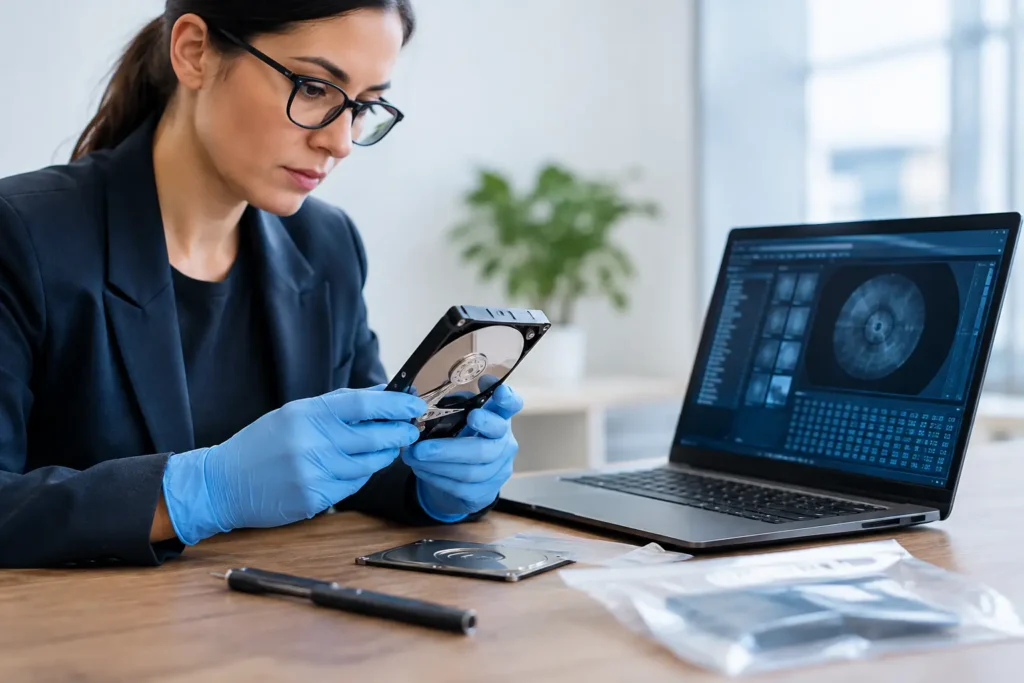
Forensic collection is designed to protect evidentiary integrity. Certified investigators can capture data from computers, mobile devices, removable media, cloud accounts, and other sources while documenting the acquisition method, preserving metadata, and maintaining chain of custody. This work helps distinguish an original file from a copied version, identify whether files were deleted or transferred, and establish a timeline that can withstand scrutiny.
That distinction matters when an investigation leads to employment action, litigation, a government inquiry, or a disclosure obligation. Counsel needs more than a collection of screenshots and exported files. They need reliable evidence, context around it, and a process they can explain.
Start with a defensible investigation plan
Speed matters, but uncontrolled speed can create unnecessary cost and exposure. Before collecting data, legal and investigation leaders should define the allegations, custodians, key time periods, likely systems, and immediate preservation risks. The plan should remain flexible because early evidence often changes the scope.
A practical plan addresses three questions: What must be preserved now? What information is needed to test the allegation? Who needs access to the evidence and investigative findings? Separating those questions prevents teams from over-collecting merely because a source is available.
Issue targeted preservation instructions
A legal hold or preservation notice should be tailored to the matter and delivered quickly to relevant custodians and system owners. It should cover obvious sources such as email and locally stored documents, but also less visible locations including mobile devices, chat platforms, shared drives, cloud storage, backup environments, and personal devices used for business.
Preservation is not a one-time event. Investigators should confirm compliance, document acknowledgments, and revisit the scope as new facts emerge. If a custodian is leaving the company or a device is at risk of being reset, forensic preservation may need to occur before interviews begin.
Select collection methods that fit the evidence
Not every investigation requires a full forensic image of every device. A narrowly scoped remote collection may be appropriate when the allegation concerns a known file path or date range. A full image may be warranted when deletion, data theft, manipulation, or misuse of external storage is suspected.
The right choice depends on the allegation, proportionality, privacy considerations, device ownership, and anticipated legal exposure. What should not change is the need to document the collection method, source details, hash values where applicable, and transfer of evidence into secure storage.
Collect beyond email without losing control
Email remains central to many matters, but it rarely tells the complete story. Employees may use text messages to coordinate activity, collaboration tools to share documents, or cloud platforms to move information outside approved channels. Mobile devices can contain messages, photos, call records, location artifacts, and application data that clarify intent or timing.
A capable forensic workflow accounts for these modern sources without treating them as separate, disconnected projects. Evidence collected from endpoints, phones, and cloud systems should be organized under a consistent matter structure, with source documentation and access controls that protect confidentiality.
Security is equally important. Investigation data may include trade secrets, health information, personnel records, privileged communications, or customer data. Teams should use controlled transfers, encrypted storage, role-based permissions, and auditable access practices. Sending sensitive exports through informal channels can create a second problem while trying to solve the first.
Turn preserved data into usable facts
Collection alone does not answer the central question: What happened? The next stage is processing and analysis. Forensic artifacts can reveal deleted files, USB activity, browser history, file access patterns, and synchronization activity. Meanwhile, eDiscovery processing makes collected ESI searchable, deduplicated, and ready for attorney review.
This is where an integrated workflow saves time. Rather than moving data among separate forensic, processing, hosting, and review vendors, teams can preserve evidence, upload it securely, process it into a reviewable format, and begin analysis in a single controlled path. Fewer handoffs reduce delays and lower the chance that critical context will be lost.
Use analytics to reduce review burden
High-volume investigations can produce hundreds of thousands of documents before the team has identified the core story. Keyword searches remain useful, but they are not enough on their own. Names may be abbreviated, communications may use vague language, and relevant documents may not contain expected terms.
Email threading can group related messages so reviewers see the full conversation rather than reviewing each duplicate reply. Near-duplicate identification can surface document families with small variations. Date filters, communication analysis, concept searching, and targeted searches can help prioritize the most relevant materials.
These tools support professional judgment rather than replacing it. Search terms and analytics should be tested against known relevant documents, adjusted based on findings, and documented when the investigation may be challenged. A smaller, well-prioritized review population is often more valuable than a broad, unfocused collection.
Keep interviews and digital evidence connected
Interviews are more effective when investigators understand the available digital evidence, but they should not disclose every finding too early. A staged approach often works best: begin with open-ended questions, test the witness’s account against known facts, then introduce specific documents or artifacts where clarification is needed.
Digital evidence can also identify people who should be interviewed next. An unexpected recipient, repeated file transfer, or late-night chat may reveal a custodian or business process that was not part of the original scope. The investigation plan should be updated as these leads develop, with decisions documented by counsel and the investigation team.
At the same time, investigators should avoid assuming that a technical artifact proves intent. A file in a synchronized folder may have been copied automatically. A deleted item may be the result of routine retention behavior. Forensic findings should be interpreted alongside witness testimony, policy requirements, business context, and the reliability of the underlying source.
Prepare for a defensible decision or production
An internal investigation may end with remediation, discipline, a policy change, voluntary disclosure, litigation, or no finding of misconduct. Each outcome requires a record that explains the process without exposing unnecessary sensitive detail.
The investigative file should preserve scope decisions, legal hold actions, collection logs, chain-of-custody records, search and review protocols, interview materials, and relevant findings. If evidence must be produced to a regulator, opposing party, or outside counsel, it should be produced in the requested format with appropriate privilege review, redactions, confidentiality designations, and quality control.
This is also the point to assess what the matter revealed about the organization. Did employees lack a clear policy for personal-device use? Are offboarding procedures leaving data accessible? Is a collaboration platform outside the current retention program? Investigation findings can improve governance when they are translated into specific operational changes.
A coordinated team reduces risk and cost
The strongest investigations pair legal direction with forensic expertise and disciplined project management. Counsel guides scope, privilege, and legal strategy. Forensic specialists preserve and interpret digital evidence. eDiscovery professionals process, organize, review, redact, and produce ESI efficiently. When those functions communicate closely, the organization can move faster without sacrificing defensibility.
ViewDox helps teams manage that full path, from certified forensic collection through secure eDiscovery processing, analytics, review, and production. The practical advantage is direct access to specialists who can adapt the workflow as facts change, rather than forcing a sensitive matter through disconnected tools and providers.
When the next allegation arrives, the most useful first step is not to collect everything. It is to preserve what matters, involve the right experts early, and build a process that gives decision-makers reliable facts when they need them.
Recent Comments