
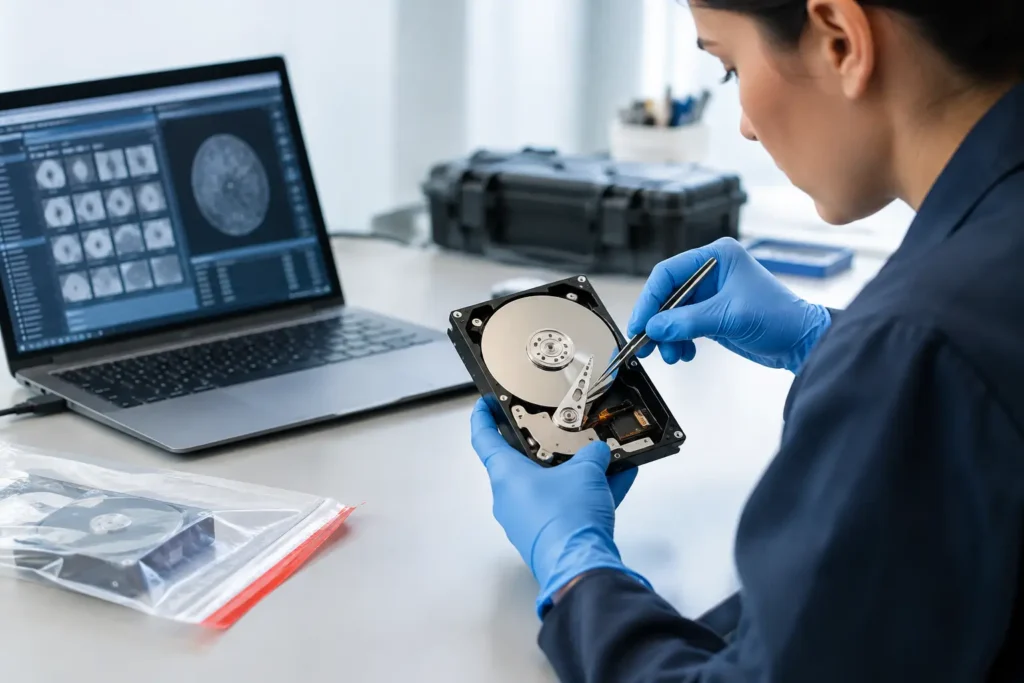
A laptop that will not boot, a wiped mobile phone, a corrupted USB drive, or a former employee’s deleted messages can change the trajectory of a matter. Forensic data recovery is the disciplined process of locating and restoring potentially relevant electronic evidence while preserving the information, metadata, and documentation needed to defend its use later.
For legal and corporate teams, recovery is not simply about getting files back. The question is whether the recovered data can be tied to a reliable source, handled without alteration, and explained clearly to opposing counsel, a regulator, or the court. That distinction separates a useful lead from defensible evidence.
What Forensic Data Recovery Actually Preserves
Conventional recovery tools are designed to make data accessible again. They may scan a drive, locate file fragments, and restore what they find to another location. That can be useful for a personal device, but it may be insufficient when the information could become evidence.
A forensic workflow begins by preserving the source. A qualified examiner documents the device or account, records its condition, captures identifying details, and uses validated methods to acquire data without writing to the original media. The acquisition is then verified with cryptographic hash values. Those values provide a way to demonstrate that the working copy and the preserved evidence have not changed.
Recovery work may involve active files, deleted files, unallocated space, system artifacts, application databases, backups, cloud-synchronized content, and file fragments. Each source tells a different part of the story. A document may be gone from a user’s desktop but remain in a cloud recycle bin, an email attachment cache, a backup set, or a synchronized mobile-device folder.
Metadata is often as consequential as the file itself. Created, modified, accessed, and sent dates, file paths, device identifiers, message participants, and account activity can establish context. A recovered spreadsheet without its surrounding metadata may be informative. A recovered spreadsheet with validated metadata and a documented chain of custody is far more useful in a legal matter.
When Recovery Is Necessary – and When It Is Not
Recovery becomes relevant when ESI is unavailable through ordinary collection methods. That can occur after accidental deletion, device damage, operating-system failure, employee departure, suspected spoliation, ransomware, or a poorly managed migration. It also arises when counsel needs to evaluate whether responsive information existed before a retention policy or user action removed it.
Not every inaccessible file requires forensic recovery. If a complete, reliable backup is available and its provenance is known, restoring from that backup may be faster and less expensive. If the issue is a cloud account with intact administrative access, targeted export and preservation may be the appropriate first step. The right approach depends on the legal question, data source, time sensitivity, and anticipated challenge to authenticity.
Recovery also has limits. Solid-state drives can permanently erase deleted data through TRIM processes. Full-disk encryption may make a powered-off device inaccessible without credentials or recovery keys. Cloud providers may overwrite or age out prior versions under their retention rules. A responsible forensic examiner does not promise that every deleted item can be restored. Instead, the examiner documents what was available, what methods were used, and what the results support.
A Defensible Recovery Workflow
Preserve before attempting repair
The most common mistake is attempting to fix a device before evidence is preserved. Rebooting a failed computer, running a repair utility, installing recovery software, or allowing a device to reconnect to the internet can overwrite relevant artifacts. It can also alter timestamps, logs, and application state.
Legal and IT teams should isolate the source when appropriate, record who possessed it, and avoid using it until an examiner can assess the situation. For a mobile device, that may mean maintaining power and limiting network connectivity. For cloud data, it may mean promptly placing the relevant account under preservation and confirming retention settings.
Acquire an authenticated forensic copy
The examiner creates an image or targeted forensic collection using methods suited to the source. A physical image can capture storage sectors and deleted data areas when the device and circumstances allow. A logical collection may be more appropriate for encrypted systems, cloud accounts, or data sets where proportionality and access constraints matter.
The collection method should be documented, repeatable, and verified. Chain-of-custody records should identify when the evidence changed hands, who performed each action, and where the data was stored. This documentation is not administrative overhead. It is the foundation for explaining why the evidence should be trusted.
Analyze artifacts in context
Recovery does not end when a file is reconstructed. Examiners assess file-system records, timestamps, logs, registry entries, browser history, application data, and user activity to determine how the information relates to the matter. A deleted file may have been created years earlier, copied recently, opened by a specific user, or transmitted through an application. Those distinctions can materially affect relevance and legal strategy.
Analysis should also account for ordinary system behavior. Timestamp changes can result from synchronization, backup activity, indexing, software updates, or time-zone settings. A technically sound finding distinguishes between what the artifacts show directly and what they may suggest. Overstating conclusions creates avoidable risk.
Move recovered ESI into eDiscovery without losing control
Once potentially relevant data is identified, it must enter the broader eDiscovery workflow. That includes secure ingestion, processing, metadata extraction, deduplication, search, analytics, review, redaction, and production. Treating forensics and review as separate projects often creates duplicate transfers, inconsistent inventories, and unnecessary cost.
An integrated workflow lets legal teams trace recovered content from the original source through review and production. Email threading can reduce repetitive review. Near-duplicate identification can group substantially similar documents. Search terms, date filters, and structured fields can focus reviewers on the data most likely to matter. The objective is not merely to recover more information, but to make the relevant information available for informed legal decisions.
Common Risks That Undermine Recovered Evidence
The technical recovery itself can be excellent and still create problems if the surrounding process is weak. Four risks appear repeatedly in sensitive matters:
- Altering the original device by using it before preservation or allowing automated updates to run.
- Relying on screenshots, exports, or copied files without preserving native data and associated metadata.
- Failing to document credentials, collection settings, hash verification, and custody transfers.
- Sending recovered data through unsecured channels or storing it outside the matter’s access controls.
These issues are manageable when legal, IT, security, and forensic teams coordinate early. The goal is to establish a collection plan before the source is handled, not after potentially relevant data has been changed or lost.
Questions Counsel Should Ask at the Start
Early case assessment should include more than custodians and date ranges. Counsel should ask what devices, applications, cloud repositories, backups, and messaging platforms may contain relevant ESI. They should also ask whether any source has been wiped, damaged, replaced, remotely managed, or subject to short retention periods.
It is equally useful to define the decision the recovery work must support. Is the purpose to locate responsive documents, investigate possible misconduct, establish a timeline, assess spoliation risk, or prepare expert testimony? A clearly defined objective helps the forensic team select an approach that is proportionate to the matter and avoids collecting more sensitive data than necessary.
Cost control belongs in that discussion. Broad physical imaging may be justified in a high-stakes investigation with suspected deletion. In another matter, targeted collection from identified accounts and backups may deliver the needed evidence with less expense and less review burden. Defensibility and proportionality should be considered together, not treated as competing goals.
Recovery Is a Legal Readiness Issue
Organizations that treat recovery as an emergency-only service often lose time when a dispute or investigation begins. A better posture is to know where critical data resides, understand retention and backup behavior, establish escalation paths for departed employees and failed devices, and identify who can authorize preservation steps quickly.
When data becomes unavailable, the response should be measured rather than improvised. Secure the source, preserve what can be preserved, document each action, and bring the recovered information into a controlled review process. With certified forensic expertise and an integrated eDiscovery workflow, ViewDox helps teams turn difficult data events into evidence they can evaluate and produce with confidence.
The most valuable recovery effort is not necessarily the one that finds the most files. It is the one that gives counsel a reliable answer, protects sensitive information, and leaves a clear evidentiary record behind.
Recent Comments