
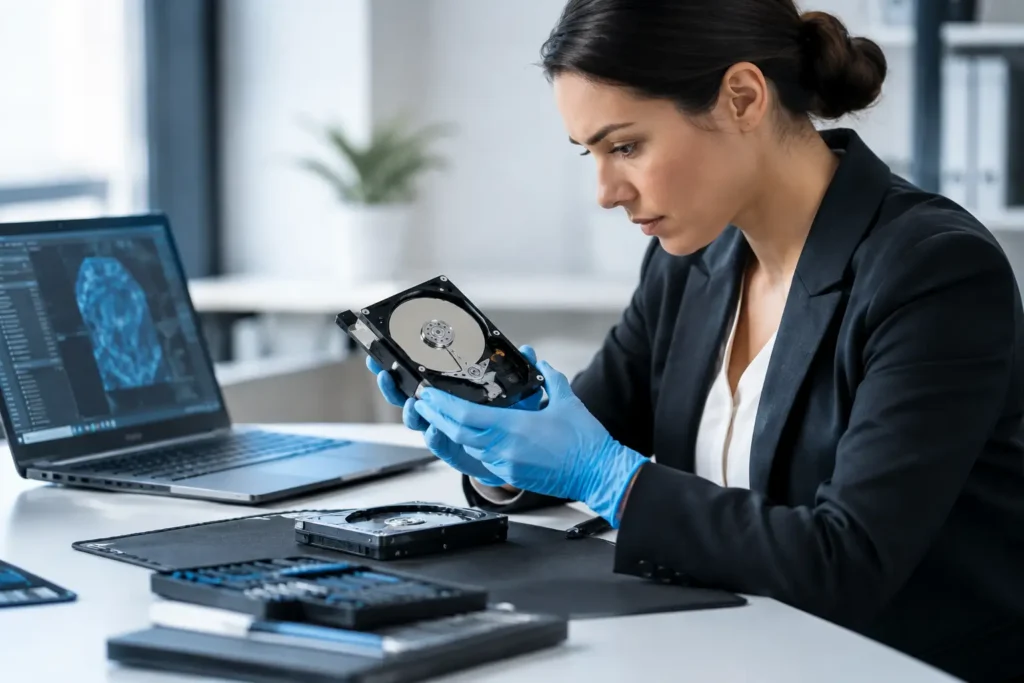
A laptop arrives after a departing executive is suspected of taking confidential files. A mobile phone may contain the only messages that explain a key decision. A cloud account can hold documents that changed after a litigation hold was issued. In each scenario, digital forensics is not simply about finding data. It is about collecting and interpreting electronic evidence in a way that can be explained, tested, and defended.
For legal, compliance, and investigative teams, that distinction changes the outcome. Data gathered quickly but without a documented method can create avoidable disputes over completeness, authenticity, or alteration. A forensic workflow provides the technical controls and reporting needed to turn a device, account, or data source into reliable evidence.
What Digital Forensics Actually Does
Digital forensics is the disciplined identification, preservation, collection, examination, and reporting of electronically stored information. The work may involve computers, servers, mobile devices, external media, email systems, cloud collaboration platforms, and business applications. The objective is to preserve the source in a defensible state while extracting information relevant to the matter.
That scope is broader than recovering deleted files. A forensic examination may establish when a file was created, modified, copied, synchronized, accessed, or deleted. It can identify user activity, connected devices, browser artifacts, system logs, application records, and communications that do not appear in an ordinary file-folder review. It can also help distinguish between an intentional transfer of data and routine system activity.
The findings are only as useful as the process behind them. Forensic investigators use validated tools, controlled procedures, cryptographic hash values, and detailed documentation to demonstrate that collected evidence matches the source and has not been changed during handling. This is what gives counsel a foundation for discussing evidence with opposing parties, regulators, experts, or the court.
Preservation Comes Before Analysis
When a potential dispute or investigation arises, the temptation is to open the device and look for answers immediately. That approach can change timestamps, overwrite temporary data, trigger cloud synchronization, or otherwise affect the very evidence the team needs to preserve.
A defensible response begins by assessing the source and the risk. Is the device powered on? Is encryption active? Is there a risk of remote wiping? Does the data reside locally, in a cloud service, or in both places? Is the custodian still actively using the device? The answer determines the appropriate collection method.
For a computer, investigators may create a forensic image that captures data at the storage level, including information not visible to the user. For a mobile device, the available acquisition method depends on the device model, operating system, security settings, and condition of the phone. For cloud sources, preservation may require targeted collection through authorized methods that retain relevant metadata and audit information.
There is no single collection method that fits every matter. A full image can provide the broadest evidentiary record, but it may require more time, storage, and downstream processing. A targeted collection can reduce cost and disruption when the issues, custodians, and date ranges are well defined. The right choice balances proportionality with the need to preserve potentially material evidence.
Chain of Custody Is an Operational Requirement
Chain of custody is often treated as a formality. In practice, it is the record that allows a legal team to account for evidence from the moment it is received through final production or testimony.
A complete record identifies the source, the person who provided it, the date and time of transfer, the collection method, the storage location, the individuals who accessed it, and the verification values used to confirm integrity. It should also document exceptions, such as damaged hardware, unavailable credentials, inaccessible cloud content, or collection limitations.
This documentation matters most when the facts are contested. If an opposing expert questions whether a file existed on a particular system, whether a device was altered, or whether the collection was complete, the team needs more than a conclusion. It needs a clear, repeatable account of what happened and why.
Secure evidence handling is equally essential. Encryption, access controls, segregated storage, and role-based permissions reduce the risk that sensitive materials are exposed or inadvertently modified. In matters involving trade secrets, employee records, regulated data, or privileged communications, security controls are part of defensibility, not a separate administrative task.
From Forensic Evidence to Reviewable ESI
Forensic collection is often the beginning of the eDiscovery lifecycle, not the end. A drive image or mobile-device extraction can contain millions of artifacts, documents, emails, and system files. Without a structured path to process and review that information, teams can spend heavily on data that never becomes useful evidence.
The most efficient workflow connects forensic collection to eDiscovery processing. Once the appropriate data is extracted, it can be filtered by date, custodian, file type, and relevance criteria; deduplicated; indexed; and prepared for review. Email threading and near-duplicate identification can reduce repetitive review while preserving context. Analytics can help teams prioritize likely relevant material and identify communication patterns that warrant closer examination.
This connection also reduces handoffs. Fragmented providers can create delays when forensic data must be exported, transferred, reprocessed, and loaded into a separate review environment. Each handoff introduces added cost, security exposure, and opportunities for confusion about data scope. An integrated workflow keeps collection records, processing decisions, review populations, and production specifications aligned.
At ViewDox, that means coordinating certified forensic collection with secure upload, processing, hosted review, redaction, and production under one project team. The practical benefit is direct: legal teams have a clearer view of what was collected, what was excluded, what is ready for review, and what can be produced defensibly.
Common Digital Forensics Challenges
Modern evidence rarely sits in one predictable location. Employees work across personal phones, company laptops, messaging platforms, cloud drives, shared collaboration tools, and external storage. A key document may exist in several versions, with different metadata and access histories. A relevant conversation may be split between email, text messages, and a collaboration application.
Deleted data presents another challenge. Deletion does not always mean a file is gone, but recoverability depends on the device, the time elapsed, encryption, system activity, and storage technology. Solid-state drives, for example, may remove deleted data quickly through automated processes. A forensic investigator should explain what can reasonably be recovered and what limitations apply rather than overstate certainty.
Remote collection can also be appropriate, particularly when custodians are geographically dispersed or devices cannot be shipped without business disruption. Yet remote work requires careful controls: verified identity, secure transfer, documented procedures, and confirmation that the collection captured the intended sources. Speed is valuable, but speed without validation can create gaps that are difficult to correct later.
When to Bring in a Forensic Specialist
Counsel does not need a forensic examination for every document request. Standard eDiscovery collection may be sufficient when data is accessible, the sources are known, and there is no meaningful concern about deletion, alteration, or hidden activity.
Forensic expertise becomes especially valuable when the matter involves allegations of data theft, employee departure, fraud, harassment, spoliation, unauthorized access, concealed communications, or disputed authenticity. It is also useful when devices are damaged, encrypted, password-protected, or likely to contain deleted or system-level evidence. Early guidance can help counsel preserve options before a device is reused, reset, or remotely wiped.
The strongest results come from collaboration between legal strategy and technical judgment. Counsel defines the issues, proportionality considerations, and legal obligations. The forensic team translates those needs into a collection plan, explains limitations in plain language, and documents each decision so the process remains defensible.
When electronic evidence may shape the case, the first question should not be, “How quickly can we search this device?” Ask what must be preserved, what the evidence needs to prove, and how the team will explain its handling when scrutiny arrives.
Recent Comments