
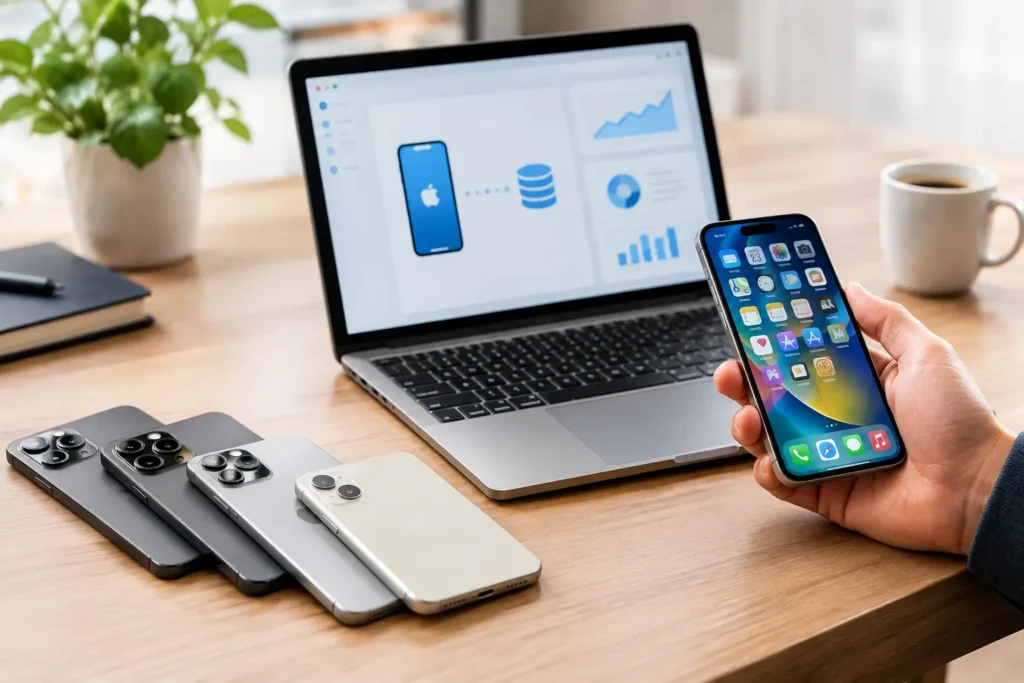
An iPhone can hold the most consequential evidence in a matter: a text message that establishes notice, a photo with location metadata, an iMessage thread missing from email, or a document shared through a consumer cloud account. Yet data collection of iPhones for discovery is not simply a matter of connecting a device and copying what appears on the screen. It requires a defensible plan that preserves relevant ESI, documents the handling of evidence, respects privacy limits, and produces usable data for review.
For litigation teams, in-house counsel, and investigators, the central question is not whether an iPhone contains data. It is which data source is authoritative, what can be collected without alteration, and whether the resulting evidence can withstand scrutiny months or years later.
Why iPhone evidence requires a forensic approach
iPhones combine communications, cloud services, application data, photos, health and location information, account artifacts, and documents in one highly personal device. The same device may be used for work and personal matters, even where a company has a BYOD policy. That creates both discovery value and collection risk.
A screenshot may be useful for an early case assessment or to preserve a particularly volatile communication. It is rarely a complete collection method. Screenshots can omit adjacent messages, timestamps, message reactions, attachments, participant details, and metadata. They also make it difficult to validate completeness, search at scale, or understand whether content was edited, deleted, or synchronized elsewhere.
A forensic workflow aims to preserve data in a repeatable manner while recording how it was acquired, who handled it, and what was done to it afterward. That documentation matters when opposing counsel, regulators, or internal stakeholders question the scope or integrity of the collection.
Start with scope before touching the device
The fastest collection is not always the right collection. Before a custodian turns over an iPhone, counsel and the forensic team should establish the purpose of the matter, applicable preservation duties, relevant date ranges, key people and topics, and the expected sources of mobile evidence.
That assessment helps determine whether the collection should focus on the physical device, an iCloud account, particular apps, enterprise mobile management repositories, carrier records, or some combination. For example, a text-message dispute may require device-level messages and attachments, while an investigation involving shared documents may call for cloud account preservation and application-specific review.
Scope also shapes privacy protections. A corporate investigation may need business communications while excluding clearly personal information outside the agreed parameters. In other matters, a neutral protocol, targeted filtering, or counsel-led review may be appropriate. The answer depends on the legal hold, the custodian’s ownership interest, employment policies, jurisdiction, and the proportionality requirements of the case.
Issue a hold that accounts for mobile behavior
A legal hold should tell custodians not to delete messages, reset or replace devices, disable cloud backups, alter relevant accounts, or use auto-delete settings for potentially responsive content. It should also address ephemeral messaging tools if they are in scope.
This instruction is practical, not ceremonial. iOS updates, storage pressure, device replacements, and routine app behavior can change what remains available. A clear hold, coupled with prompt collection, reduces the risk that relevant mobile evidence will disappear before it can be preserved.
Choose the right collection path
There is no universal “iPhone image” that captures every possible source. Modern iOS security, device model, operating system version, encryption status, passcode availability, cloud synchronization, and application design all affect what can be acquired. A qualified examiner should explain the available methods and their limitations before collection begins.
A logical acquisition can collect user-accessible data and may be appropriate when the device is unlocked, the scope is targeted, and the required sources are available through supported extraction methods. It can be efficient for messages, call records, media, contacts, and certain application artifacts.
A file-system acquisition can provide a deeper view of available files and databases where supported. It may offer richer artifacts, including data that is not readily visible to the user. However, access varies by device and iOS version, so teams should avoid promising a particular result before the examiner has assessed the device.
Cloud collection may be essential where iCloud holds synced messages, photos, backups, files, notes, or other content not present on the handset. It can also be the better route when a device is unavailable, damaged, or no longer in the custodian’s possession. Cloud content presents its own issues, including authentication, account ownership, retention settings, and the possibility that synced data differs from what existed on the device at a particular time.
For some matters, the most defensible approach combines these sources. The device may show local artifacts and current settings, while a properly authorized cloud collection captures preserved account content. The collection decision should be driven by facts, not by a preference for the broadest possible extraction.
Preserve chain of custody and collection metadata
A defensible iPhone collection creates a record before the first extraction starts. That record should identify the device, its condition, the custodian, collection date and time, examiner, acquisition method, and the handling of passcodes and credentials. Device identifiers, operating system version, available storage, battery condition, and visible damage can also be relevant.
The examiner should preserve the original collection output, calculate and record hash values when the data format supports them, and maintain secure storage with controlled access. Working copies used for processing and review should be traceable to the original evidence.
Chain of custody is not paperwork for paperwork’s sake. It allows the legal team to answer straightforward questions with confidence: What was collected? From which source? By whom? When? Has the evidence changed? When collection choices are challenged, contemporaneous documentation is far more persuasive than a reconstruction created after the fact.
Turn mobile evidence into reviewable ESI
Collection is only the first stage. Raw mobile data may contain database files, attachment directories, proprietary formats, duplicates, system artifacts, and personal information. To become useful in discovery, relevant content needs to be processed into formats that preserve family relationships, searchable text, normalized dates and times, participants, and associated metadata.
Messages deserve special attention. A production that separates attachments from their source messages or loses group-chat context can change how evidence is understood. Review platforms should preserve the conversation structure wherever possible, while allowing reviewers to search, tag, redact, and export responsive content efficiently.
Analytics can reduce review burden after processing. Email threading may have limited value for a text-heavy collection, but near-duplicate identification, search-term reporting, concept analysis, date filtering, and communication mapping can help teams prioritize the evidence that matters. The appropriate analytics depend on the data set and the questions the matter needs to answer.
At ViewDox, certified forensic collection can feed directly into secure eDiscovery processing and review workflows, reducing handoffs between separate vendors. That continuity helps project teams move from preservation to analysis without losing sight of the collection record.
Common mistakes that create avoidable risk
The most damaging errors are often operational. Waiting for a custodian to upgrade or replace a device before collecting it can eliminate locally available data. Relying on screenshots alone can limit context and make authenticity disputes harder to resolve. Using informal exports without documenting their source and method can leave gaps in the chain of custody.
Another common mistake is treating the phone as the entire universe of evidence. An iPhone may point to iCloud, Microsoft 365, Google services, Slack, Signal, WhatsApp, social media, file-sharing apps, or a mobile-device-management environment. Each source may have different retention rules and legal access considerations.
Overcollection has consequences too. Taking everything from a personal device without a defined protocol can increase privacy exposure, review costs, and privilege risk. A focused, documented scope is usually more defensible than an indiscriminate acquisition, provided it is sufficient for the preservation obligations at hand.
A practical workflow for data collection of iPhones for discovery
An effective workflow begins with counsel defining scope and issuing preservation instructions. A forensic examiner then evaluates the device, access credentials, operating system, cloud dependencies, and feasible acquisition options. The selected data sources are collected under documented chain-of-custody procedures and preserved in secure evidence storage.
Next, the data is processed into reviewable ESI, with mobile conversations, attachments, metadata, and custodial fields maintained as accurately as the source permits. The legal team can then apply search, analytics, redactions, and quality control before producing responsive material in the required format.
This sequence protects speed without sacrificing defensibility. It also gives stakeholders a clear picture of cost and risk early enough to make informed decisions rather than reacting to a failed export or a missing device later in the matter.
When iPhone evidence may affect the outcome of a dispute or investigation, treat the collection decision as part of the legal strategy. Early guidance from a forensic and eDiscovery team can preserve the evidence, narrow the review burden, and give counsel a reliable foundation for the decisions that follow.