
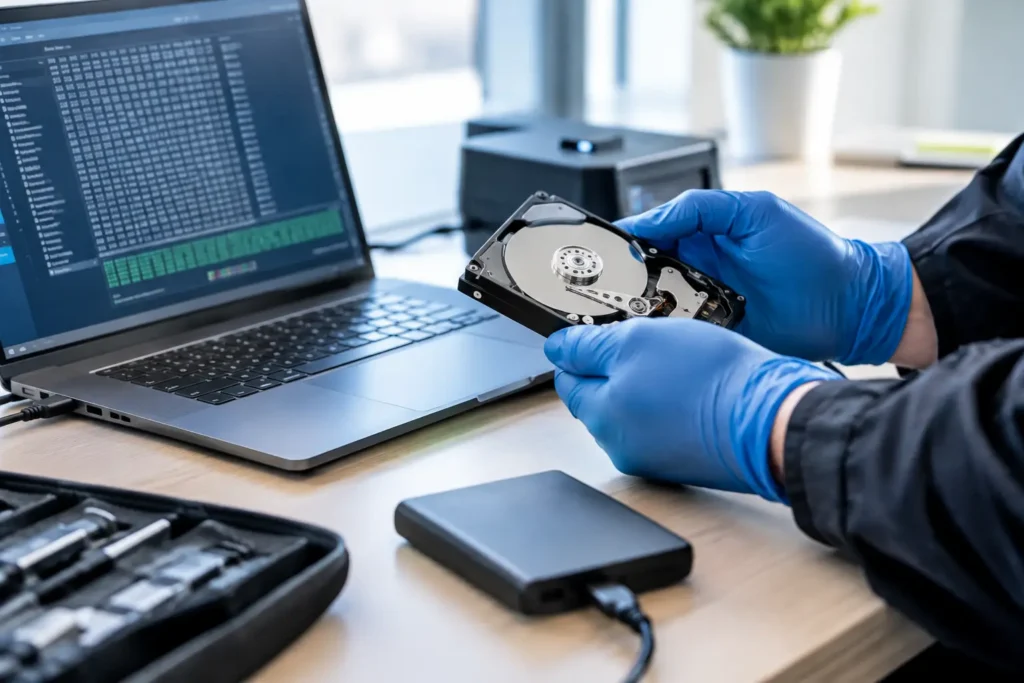
A production deadline can expose weaknesses that began weeks earlier at collection. A missing cloud-folder path, an altered mobile device, incomplete metadata, or an undocumented handoff can turn a routine production into a dispute about evidence integrity. Forensic data collection for discovery production addresses that risk at the source by treating collection, preservation, processing, review, and delivery as one defensible workflow.
For legal teams, the objective is not simply to gather data quickly. It is to collect the right data in a manner that can be explained, repeated where necessary, and produced in the required format without compromising confidentiality or chain of custody. That requires forensic discipline, practical project management, and a clear understanding of what downstream review and production will demand.
Why forensic collection changes the production outcome
Electronic evidence rarely arrives in a neat, static archive. Relevant ESI may sit across employee laptops, mobile devices, Microsoft 365 or Google Workspace accounts, text messages, shared cloud repositories, collaboration platforms, databases, and external storage media. Each source creates different preservation, access, metadata, and authentication considerations.
A forensic approach preserves more than the visible document or message. It captures information that may matter later, such as file-system details, creation and modification dates, custodian context, message relationships, source locations, and collection logs. Where appropriate, it also preserves the original evidence in a verified format so the working copy used for processing and review does not become the only record of what was collected.
That distinction matters when opposing counsel questions completeness, when a regulator requests provenance, or when an internal investigation requires confidence that evidence has not been changed. It also matters for efficiency. Clean, well-documented source data is easier to process, search, deduplicate, review, redact, and produce accurately.
Start with a collection plan that serves the case
A defensible collection does not begin by imaging every device in sight. Overcollection can increase hosting and review costs, introduce privacy issues, and delay access to the evidence that actually matters. Undercollection creates a different risk: omissions that are expensive to correct after review has already begun.
The collection plan should connect the legal hold, matter scope, and anticipated production specifications. Counsel, IT, investigators, and eDiscovery project managers should align on the relevant date range, custodians, repositories, data types, priority sources, and potential sources of privileged or highly sensitive information. If the matter involves employee departures, trade secrets, or alleged data exfiltration, endpoint artifacts and mobile-device evidence may deserve immediate attention. If the dispute centers on contract negotiations, email, shared drives, collaboration tools, and mobile messages may be more central.
Scope can evolve as facts develop. The key is to document why a source was included, excluded, or deferred. A documented decision is far easier to defend than an assumption made under time pressure.
Preservation comes before convenience
Preservation choices should reflect the nature of the data source. A live laptop may require a forensic image or targeted collection depending on the matter, proportionality, and business needs. A cloud account may require a defensible export that retains available metadata, folder context, and native files. A mobile device may require specialized acquisition methods that account for device model, operating system, encryption, and available access.
There is no single collection method that fits every matter. Full forensic imaging provides a broad evidentiary record but can be costly and unnecessary for a narrowly defined dispute. Targeted collection reduces volume and can move faster, but it depends on a reliable scope and careful validation. The appropriate choice is the one that meets the legal and investigative need while maintaining defensibility.
Build chain of custody into every handoff
Chain of custody is not a formality saved for a declaration. It is the operational record that shows who handled evidence, when they handled it, what actions were taken, and how integrity was maintained. For physical media and devices, that record should follow the evidence from receipt through storage, acquisition, analysis, and return or disposition. For cloud and remote collections, collection logs and source-account details serve a similar purpose.
Hash values are a central control when collecting digital evidence. By recording a cryptographic hash of the acquired data and verifying it during later transfers, the team can demonstrate that the working copy matches the source acquisition. This is particularly valuable when data moves between collection personnel, processing environments, review platforms, and production teams.
A practical chain-of-custody process should document at least the following:
- The evidence source, custodian, and unique identifier
- The collection date, time, method, and personnel involved
- The original and verified hash values when applicable
- Each transfer, storage location, and access event
- Any exceptions, access limitations, or collection errors
These records help forensic experts prepare declarations and help legal teams answer questions before they become motion practice.
Preserve metadata and context for review
Metadata is often the difference between a searchable production and a difficult reconstruction. A filename alone may not reveal whether a document was attached to an email, stored in a particular project folder, created by a specific custodian, or modified during the relevant period. For messages, family relationships between parent emails and attachments must be preserved. For modern cloud content, conversation context, version information, and shared locations may also be relevant.
Collection teams should identify early which metadata fields the review team and receiving party will need. The production protocol may call for load files, native files, TIFF or PDF images, extracted text, Bates numbering, confidentiality designations, and specific metadata fields. Knowing those requirements before processing allows the team to identify gaps and avoid re-collecting data after deadlines tighten.
This does not mean every available metadata field must be produced. Privacy, privilege, confidentiality, and proportionality still govern the process. It means the data should be collected and handled in a way that gives counsel informed choices later.
Move from collection to review without creating new risk
A fragmented workflow creates unnecessary exposure. When collection, processing, hosting, review, and production occur across disconnected vendors, files may be copied repeatedly, specifications may be interpreted differently, and responsibility for errors can become unclear. A coordinated workflow keeps evidence handling visible from the first acquisition through final delivery.
After collection, data should enter a secure processing environment where it can be indexed, deNISTed when appropriate, deduplicated, date-filtered, and normalized for review. Analytics can reduce review burden further through email threading, near-duplicate identification, concept searching, and targeted prioritization. These tools do not replace legal judgment. They help reviewers focus on the documents most likely to matter while reducing repetitive review.
Security must remain active throughout this transition. Sensitive ESI should be protected through controlled access, encrypted transfer and storage, role-based permissions, and auditable activity records. For matters involving personal information, health information, financial records, or trade secrets, the review workflow should also support precise redaction and quality control before production.
Quality control is part of production, not a final checkbox
Production errors are often preventable. Common issues include missing attachments, broken family relationships, incorrect Bates ranges, incomplete redactions, native-file mismatches, faulty load files, and documents that were tagged incorrectly during review. A production that technically delivers files but fails to meet the agreed protocol can still create delay, added cost, and credibility concerns.
Quality control should begin before export. The project team should validate the responsive set, privilege and confidentiality designations, redaction burn-in, document family treatment, image quality, metadata fields, and production numbering. The final deliverable should be tested in the same manner the recipient is expected to load or access it.
For high-stakes matters, a second set of experienced eyes is often worth the time. The cost of a targeted QC review is generally lower than the cost of correcting an erroneous production, notifying opposing counsel, and reviewing whether protected information was disclosed.
Expert guidance makes defensibility practical
Legal teams need more than a collection tool. They need specialists who can explain the available options, identify risks early, and keep the process moving when a custodian is remote, a device is locked, a cloud account is complex, or a production deadline is fixed.
ViewDox combines certified forensic collection with secure eDiscovery workflows so evidence can move from acquisition to processing, analytics, review, redaction, and production under coordinated project management. That approach gives counsel clearer visibility into the data lifecycle and reduces the operational friction of managing separate providers.
The best time to solve a production problem is before the data is collected. A disciplined plan, documented forensic methods, and active quality control give your team a stronger record when the evidence is challenged and a clearer path when the deadline arrives.